
How the ROI model works
A plain-language explanation of the LFX contribution ROI model, with no math required — revealed preference, the three steps, and what the model does and does not measure.
Last updated
This page explains the approach in plain language. No math is needed. The technical section has the formulas.
The question
Organizations spend real money and staff time on open source: engineers write code, staff join project meetings, companies pay membership fees, sponsor events, and send people to conferences. The model asks:
- How much value does an organization get from this contribution?
- How does that value compare with what it costs?
- How does this differ across organizations, projects, and kinds of contribution?
The core idea: actions reveal value
We cannot see the value an organization gets from open source. It might be better products, access to innovation, hiring, influence over a project's direction, or lower risk. Organizations rarely report it, and it differs for each.
We can see what organizations do. The idea is called revealed preference:
If an organization keeps investing time and resources in a project, year after year, across several kinds of contribution, then the project is probably worth at least what it costs.
For example, if Company X invests heavily in Project Y every year in code, meetings, and sponsorship, we infer it sees a positive return on that investment. If the investment were not worthwhile, it would likely have stopped.
This is an assumption, albeit an important one and the basis of the entire model. It implies further assumptions: that organizations are rational, have consistent preferences over time, and have good information. It may not hold in every case, but it gives a useful starting point for estimating perceived value from observable behavior.
An advantage of this approach is that the model does not need to know why an organization contributes. It does not assume any particular benefit. It uses the pattern of behavior to estimate how much value the organization must perceive. That lets the model generalize across organizations, projects, and types of contribution without knowing the motivation behind each action.
Three steps
1. Measure the investment  →  2. Infer perceived value  →  3. Compute the return
   (data)                       (model and estimation)        (inference)
1. Measure the investment. Every resource an organization puts into a project is converted into dollars.
- Money spent directly (membership fees, sponsorships, event tickets, training courses) is used as recorded.
- Staff time is estimated from activity records such as commits, pull requests, issues, and meeting attendance. Each activity type is assigned an estimated number of hours, converted to full-time-equivalent (FTE) effort, and valued at a flat benchmark salary. The salaries are the same for every organization. They are not derived from anyone's actual or reported compensation.
2. Infer perceived value from behavior. The model looks at two things:
- Whether an organization contributes to a project, and how consistently over time. Organizations that contribute more persistently reveal more perceived value. This yields a markup: the value perceived per dollar of direct cost. A markup of 1 means the perceived value equals the cost of an efficiently allocated portfolio. A markup of 3 means the organization behaves as if each dollar of efficient cost returns about three dollars of value. The return on what the organization actually spent is the markup scaled down by how efficiently its mix of contributions matches the fitted one.
- The model recovers a ranking of organization-project pairs by two methods (a logistic regression and a direct ranking by activity rate). The ranking is then converted to markups using survey data from the LF Research ROI for Open Source Software Contribution survey.
- How it spreads its effort across contribution types. This shows which types matter most for a given organization and how easily it swaps one type for another.
3. Compute the return. The markup is applied to the cost of the contribution portfolio to get an estimated contribution value. Comparing value with investment gives ROI and the benefit-cost ratio.
What the full model pipeline looks like
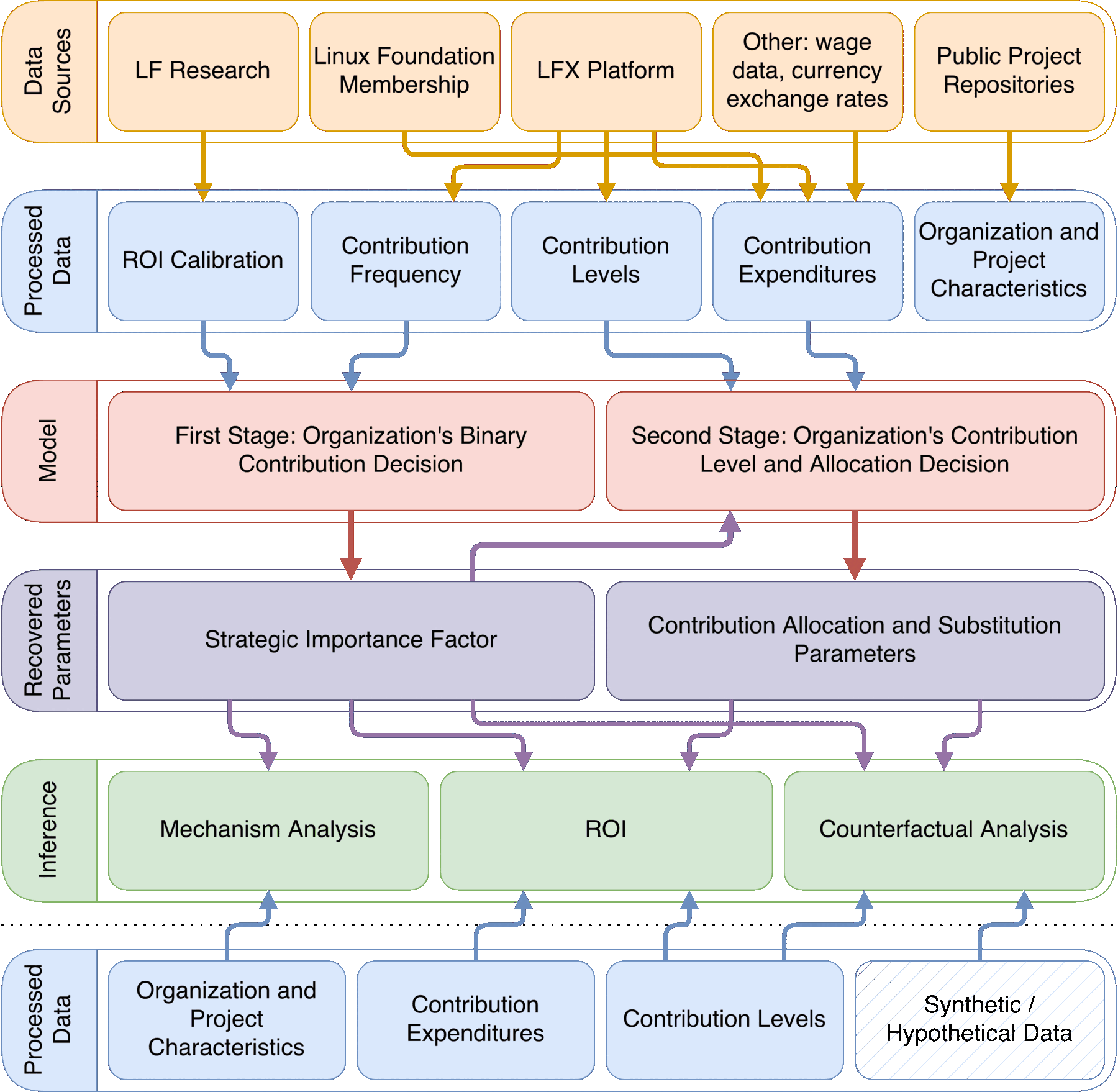
- Data sources and processed data. LFX and Linux Foundation records (platform activity, memberships, events, courses), public project repositories, wage benchmarks and currency exchange rates (flat constants, not anyone's actual or reported compensation), and LF Research survey results are turned into processed datasets: contribution frequency (does an organization contribute to a project each month?), contribution levels and expenditures (how much, in units and dollars), organization and project characteristics, and the survey-based ROI calibration.
- Model. Two stages. The first models the organization's binary decision to contribute to a project. The second models how much it contributes and how it allocates effort across contribution types.
- Recovered parameters. The first stage recovers a strategic importance factor, the markup. The second recovers the allocation and substitution parameters: how much weight each contribution type carries and how easily one substitutes for another. The markup also feeds the second stage.
- Inference. The recovered parameters are combined with the processed data to compute ROI. The diagram also shows mechanism analysis and counterfactual analysis. These are part of the research methodology but are not available on the ROI page.
What the model is and is not
- Mechanism agnostic. It does not claim contribution pays off through any one channel.
- A measure of what organizations invest. It values the cash and time organizations put in. It does not estimate the value of the software itself, unlike COCOMO-style methods that price lines of code.
- Applicable to any organization type. It only assumes organizations act in line with their goals.
- Model-based. Estimates are useful for comparison and for seeing the scale of an investment. They are not audited accounting figures. See Interpreting results.
- Silent on use value. The overwhelming majority of OSS users do not contribute at all, yet obviously derive value from using the software. The ROI model focuses solely on the perceived value of contributing, not of using, the software. In this sense, contribution ROI underestimates the total value generated by open source projects.